
When Should You Register for GST? A Simple Guide With Real Numbers
If you’re starting a small business in India, one of the first confusing questions you’ll run into is: When to register for GST (Goods and Services Tax) number right away, or only once I start making money? GST is India’s single indirect tax on the sale of goods and services, replacing the older, fragmented tax system. The honest answer to when you need to register is: it depends on your turnover and what kind of business you run and getting it wrong in either direction can cost you.
A Bit of Background First
Before July 1, 2017, India had several separate taxes – excise duty, service tax, VAT, and others – each with its own rules depending on the state. On that date, the government replaced all of them with one single tax: the Goods and Services Tax (GST). That’s why every invoice today, no matter which state you’re in, follows the same basic structure.
So, From Day One or After a Certain Turnover?
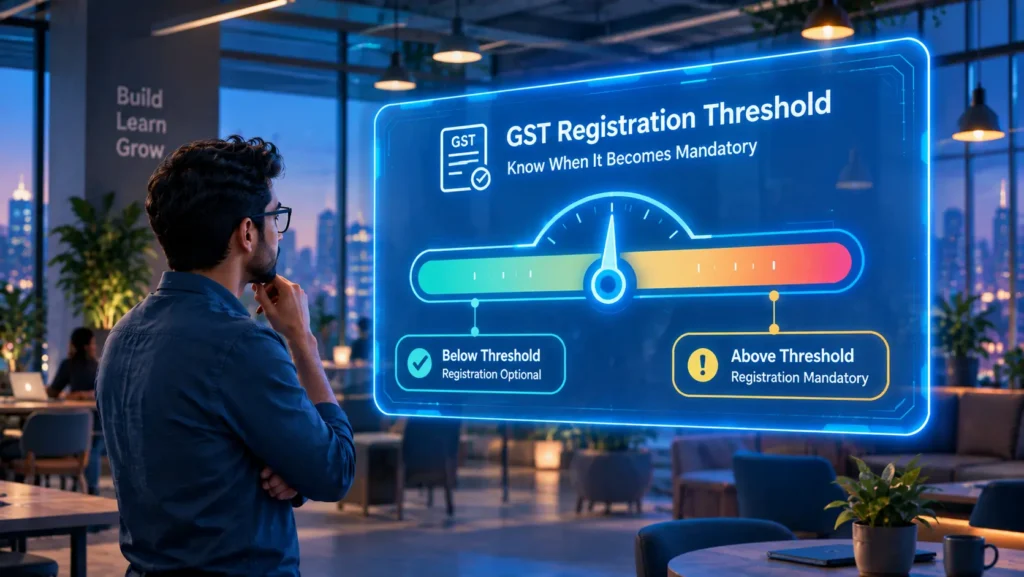
For most small businesses, GST registration isn’t required from day one – it becomes mandatory only after you cross a specific turnover threshold. Here’s what that threshold actually is:
- Goods sellers: GST registration becomes mandatory once your annual turnover crosses ₹40 lakh in most states.
- Service providers (and mixed businesses): the threshold is ₹20 lakh.
- Special category states (including states like Manipur, Mizoram, Nagaland, and Tripura): the threshold drops to ₹10 lakh for services.
Turnover here means your total sales across India under the same PAN (Permanent Account Number) – not just sales within one state.
But There Are Exceptions – Some Businesses Must Register Regardless of Turnover
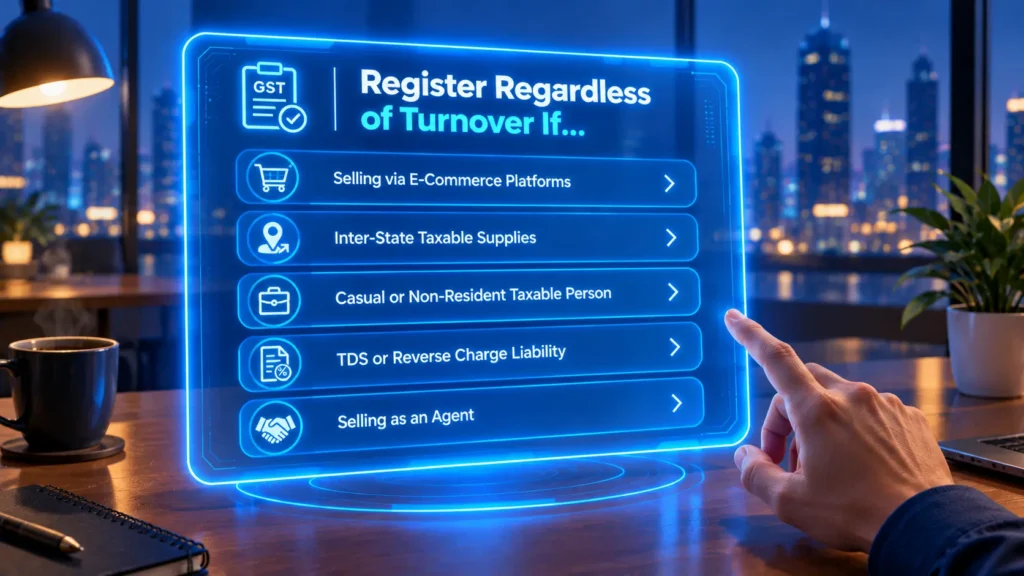
Even if you’re nowhere near the threshold, GST registration becomes compulsory immediately if:
- You sell through an e-commerce platform (as a seller or operator)
- You make inter-state (cross-state) taxable supplies – with a small exception for service providers under the threshold
- You’re a casual taxable person (occasional/seasonal seller with no fixed place of business) or a non-resident taxable person
- You’re required to deduct tax at source under GST, or pay tax under the reverse charge mechanism
- You sell on behalf of someone else, as an agent
If any of these apply to you, the turnover threshold doesn’t matter – you need to register before you start selling.
Can You Register Voluntarily, Even Below the Threshold?
Yes. Many small businesses choose to register for GST early, even if they’re under the limit, because it lets them claim Input Tax Credit (ITC – essentially, tax you paid on business purchases, which you can offset against tax you collect), and it can make larger clients more comfortable working with you, since some businesses only work with GST-registered vendors.
The trade-off: once registered, you’re required to file returns and follow GST invoicing rules, even in months with low or no sales. It’s a genuine decision, not an automatic yes.
What Actually Has to Be on a GST Invoice
Once you’re registered, here’s what a compliant invoice needs:
- A unique invoice number and date
- Your business name, address, and GSTIN (Goods and Services Tax Identification Number)
- Your customer’s GSTIN, if they have one
- The Harmonized System of Nomenclature (HSN) code for goods, or Services Accounting Code (SAC) for services
- The price before tax, the GST amount, and the final total
The Part That Confuses People: CGST vs SGST vs IGST
This comes down to one question: is your customer in your state, or a different one?
- Same state: the tax splits in half – Central Goods and Services Tax (CGST) and State Goods and Services Tax (SGST), 50/50.
- Different state: the whole tax goes under one label, Integrated Goods and Services Tax (IGST).
A real example: you sell a laptop for ₹50,000, taxed at 18%.
Same state: CGST ₹4,500 + SGST ₹4,500 = ₹9,000 tax → Total ₹59,000
Different state: IGST ₹9,000 → Total ₹59,000
Same final bill, different split.
Common Mistakes
- Registering too early ‘just in case’, then struggling with monthly return filing for a business that isn’t generating much revenue yet
- Registering too late – after already crossing the threshold – which can mean penalties and interest on unpaid tax
- Charging CGST + SGST on an inter-state sale instead of IGST
- Forgetting the HSN/SAC code on invoices
FAQ (Frequently Asked Questions):
Do freelancers need a GST number?
Only once their turnover crosses ₹20 lakh (or ₹10 lakh in special category states), unless a mandatory category applies – like selling through an e-commerce platform.
What happens if I cross the threshold and don’t register?
You can face penalties and be required to pay the tax you should have collected, plus interest, once discovered.
Can I cancel my GST registration if my turnover drops later?
Yes, through Form GST REG-16, once pending returns are filed and dues are cleared.
Does export income count toward the threshold?
Yes – exports are included in aggregate turnover even though they’re zero-rated.
Final Takeaway
Most small businesses don’t need to register for GST on day one – only once turnover crosses ₹40 lakh (goods) or ₹20 lakh (services), unless a mandatory category applies regardless of turnover. Since rules and thresholds can be updated, always confirm your specific situation against the current official rules before deciding.
This article explains general GST rules and isn’t personal tax advice. For your specific situation, a GST practitioner or chartered accountant can confirm what applies to you.
Sources & References
- GST Portal (Government of India) – official registration and rules – https://www.gst.gov.in/
- Central Board of Indirect Taxes and Customs (CBIC) – official notifications and current rates – https://www.cbic.gov.in/