
Common Invoicing Mistakes Freelancers Make (Beyond Just GST Errors)
Invoicing mistakes freelancers make aren’t usually about tax rates or missing GST fields – those are their own category, and worth getting right, but they’re not what causes most payment delays and disputes. The bigger, more common mistakes happen at the business level: unclear terms, poor records, and invoices that sit unpaid because nobody follows up properly.
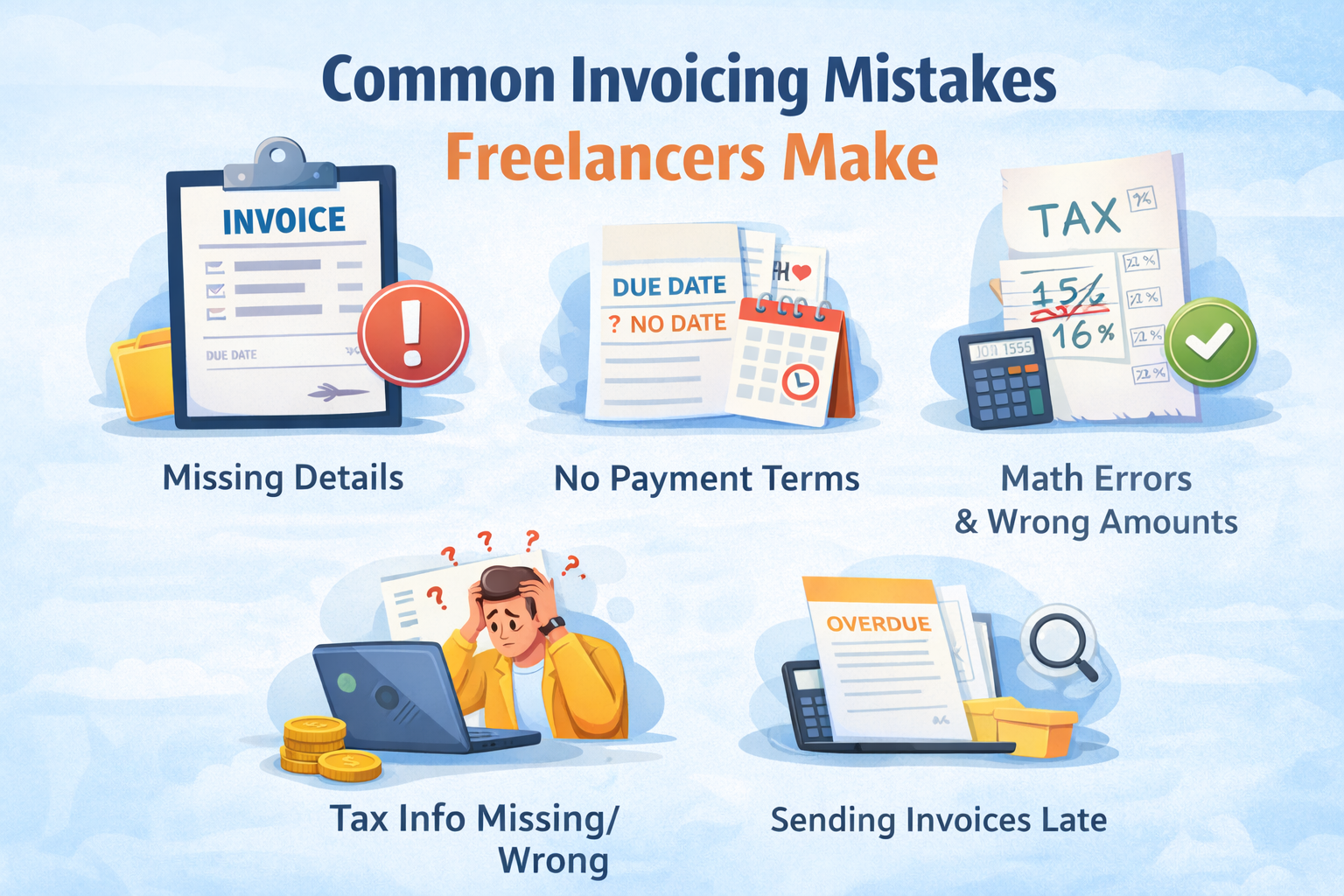
No Written Scope Before the Invoice Exists
A surprising number of invoice disputes don’t start with the invoice – they start with a scope that was never written down. If “redesign the website” wasn’t defined anywhere, the client can genuinely believe two rounds of revisions were included, while you were billing for a third round as extra work. By the time the invoice arrives, you’re arguing about scope, not paying an agreed amount.
The fix isn’t complicated: a short written scope, even a few lines in an email the client confirms, before work starts. The invoice should then reference exactly what was agreed, not just a lump total.
Vague or Missing Payment Terms
“Payment due” without a specific number of days is an invitation to be paid last. Clients prioritize invoices with clear deadlines over ones that feel open-ended, and vague terms make it awkward to follow up later, since there’s no actual date you can point to.
Every invoice should state payment terms explicitly – for example, “Payment due within 15 days of invoice date” – along with what happens if that date passes, even something simple like “A reminder will be sent after 7 days past due.”
Inconsistent or Reused Invoice Numbers
Reusing invoice numbers, or numbering inconsistently across clients, creates real problems beyond looking unprofessional: it makes it hard to track what’s been paid, complicates your own bookkeeping, and can cause issues if a client’s accounts team cross-checks invoice numbers against payments received. A simple sequential system – even something as basic as INV-2026-001, INV-2026-002 – solves this without needing invoicing software.
Not Keeping Proper Records
Freelancers often keep the sent invoice and consider that enough. But once GST registration applies, invoice-related records must generally be retained for 72 months (6 years) from the due date of the relevant annual return, under Section 36 of the Central Goods and Services Tax (CGST) Act. Even without GST registration, the Income Tax Act generally expects supporting business records to be kept for several years in case of an assessment.
Beyond just the sent invoice, this means keeping the underlying agreement, payment confirmations, and any related correspondence – not just a PDF that gets buried in a downloads folder.
Accepting Large Cash Payments Without Thinking It Through
This one surprises people: since April 1, 2026, Section 186 of the Income Tax Act, 2025 (which replaced the earlier Section 269ST of the 1961 Act) prohibits receiving ₹2 lakh or more in cash from a single client in a day, for a single transaction, or across payments tied to one project or event. The limit applies to the person receiving the cash – meaning you, the freelancer – and the penalty is equal to the entire cash amount received, not a percentage of it. For any invoice approaching that value, insist on a bank transfer or another traceable payment method instead.
Sending Invoices Late – or Not Following Up At All
An invoice sent weeks after the work is delivered signals that payment isn’t urgent, and clients respond accordingly. On the other end, an invoice that goes unpaid with no follow-up often just gets forgotten, not deliberately ignored.
A simple two-part habit fixes both: invoice within a day or two of delivering the work, and send a polite, specific follow-up once the due date passes rather than waiting indefinitely and hoping.
No Currency or Country Details for International Clients
For freelancers billing clients outside India, an invoice without a clearly stated currency, or without the export declaration GST requires under a Letter of Undertaking (LUT), can create confusion about the amount owed and compliance gaps that surface later. This is its own detailed topic, but the short version: international invoices need explicit currency and a few extra fields domestic invoices don’t.
Common Mistakes (Quick Recap)
1. Invoicing against a scope that was never written down or confirmed
2. Leaving payment terms vague instead of stating a specific due date
3. Reusing or inconsistently numbering invoices across clients
4. Not retaining invoice-related records for the required period
5. Accepting cash payments of ₹2 lakh or more without realizing the legal limit
6. Sending invoices late, or not following up once they’re overdue
FAQ (Frequently Asked Questions)
Do I legally need a written scope before invoicing a client?
Not legally required for most freelance work, but it’s the single most effective way to prevent invoice disputes, since it gives both sides something concrete to reference.
How long do I actually need to keep old invoices?
If you’re GST-registered, generally 72 months (6 years) from the due date of the relevant annual return. Even without GST registration, keeping records for several years is a reasonable practice in case of an income tax assessment.
Can a client legally pay me ₹2 lakh in cash if we split it across two days?
No – the restriction applies to cash received from the same person across related transactions or a single event, so splitting a payment across days to stay under the limit doesn’t avoid the rule.
What’s a reasonable payment term to set as a freelancer?
There’s no single correct answer, but 7 to 15 days is common and generally reasonable for freelance work; longer terms increase the risk of delayed payment.
How do freelancers issue invoices in India?
Typically through invoicing software, a template, or a free tool that includes an invoice number, date, your and the client’s details, an itemized description of the work, the total amount, and payment terms – plus mandatory GST fields if you’re registered.
What’s a good invoicing tool for freelancers?
A good invoicing tool should support GST-compliant fields, consistent sequential invoice numbering, multi-currency billing for international clients, and easy access to past records – the specifics matter more than the brand. Free tools like GetSnapBill are built around exactly these requirements.
How do I create an invoice for freelance work?
At minimum, include an invoice number, date, your business details, the client’s details, an itemized description of the work, the total amount, and clear payment terms. If you’re GST-registered, additional mandatory fields apply – see our full guide to GST-compliant invoices for the complete list.
Final Takeaway
Most invoicing mistakes freelancers make have nothing to do with tax fields – they’re business-practice gaps: no written scope, vague terms, poor records, and invoices that quietly go unpaid because nobody followed up. Fixing these is mostly about consistency, not complexity.
This article explains general invoicing practices and isn’t personal financial or legal advice. For your specific situation, a chartered accountant can confirm what applies to you.
Sources & References
– Central Board of Indirect Taxes and Customs (CBIC) – Section 36 of the CGST Act, record retention requirements – https://www.cbic.gov.in/
– Income Tax Department (Government of India) – cash receipt restrictions under the Income Tax Act, 2025 – https://www.incometax.gov.in/