
GST on Invoices in India – Explained (With Example)
If you’ve ever opened an invoice template online and wondered whether it actually meets the rules for Goods and Services Tax (GST), you’re not alone. A GST-compliant invoice isn’t about looking professional – it’s a legal document with a specific list of required details. Miss one, and your customer’s Input Tax Credit (ITC) claim may be rejected or you can face questions during a GST audit.
What Makes an Invoice ‘GST-Compliant’?
There’s no official visual template you have to follow – you can use any layout, any software, any design. What matters is that the invoice contains every field required under Rule 46 of the Central Goods and Services Tax (CGST) Rules, 2017, issued under Section 31 of the CGST Act. As long as those fields are present and correct, the invoice is compliant, regardless of how it looks.
The Fields That Must Be on Every GST Invoice
Rule 46 lists 16 required particulars. In plain terms, here’s what that means for a typical invoice:
- Your business name, address, and Goods and Services Tax Identification Number (GSTIN)
- A unique, sequential invoice number (up to 16 characters, resetting each financial year)
- Invoice date
- Customer’s name, address, and GSTIN (if registered)
- Harmonized System of Nomenclature (HSN) code for goods, or Services Accounting Code (SAC) for services
- Description of the goods or services
- Quantity and unit, where applicable
- Taxable value (the price before tax)
- The applicable GST rate
- Tax amount, split into Central Goods and Services Tax (CGST) and State Goods and Services Tax (SGST), or Integrated Goods and Services Tax (IGST)
- Place of supply (required for inter-state sales)
- Total invoice value
- Whether tax is payable under reverse charge
- Signature (physical or digital) – not required for e-invoices, since the Invoice Registration Portal signs those automatically with an Invoice Reference Number (IRN)
One detail people miss: for B2C sales of ₹50,000 or more, you must include the buyer’s name, address, and state code – even if the buyer doesn’t have a GSTIN.
When You Must Issue the Invoice
Timing matters as much as content:
- Goods: the invoice must be issued before or at the time the goods are removed or delivered.
- Services: you have up to 30 days from the date the service was provided.
Issuing late doesn’t just look unprofessional — it can create mismatches when your customer tries to reconcile their Input Tax Credit against your filed returns.
Do You Need to E-Invoice?
Not every business does. As of the current rules, e-invoicing is mandatory only if your Annual Aggregate Turnover (AATO) crosses ₹5 crore (Notification No. 17/2025-CT). Below that threshold, a regular invoice with all Rule 46 fields is fine – you don’t need to route it through the Invoice Registration Portal.
If you are above the threshold, the invoice needs a signed QR code containing the IRN before it goes to the buyer.
CGST, SGST, and IGST – Working Out the Split:
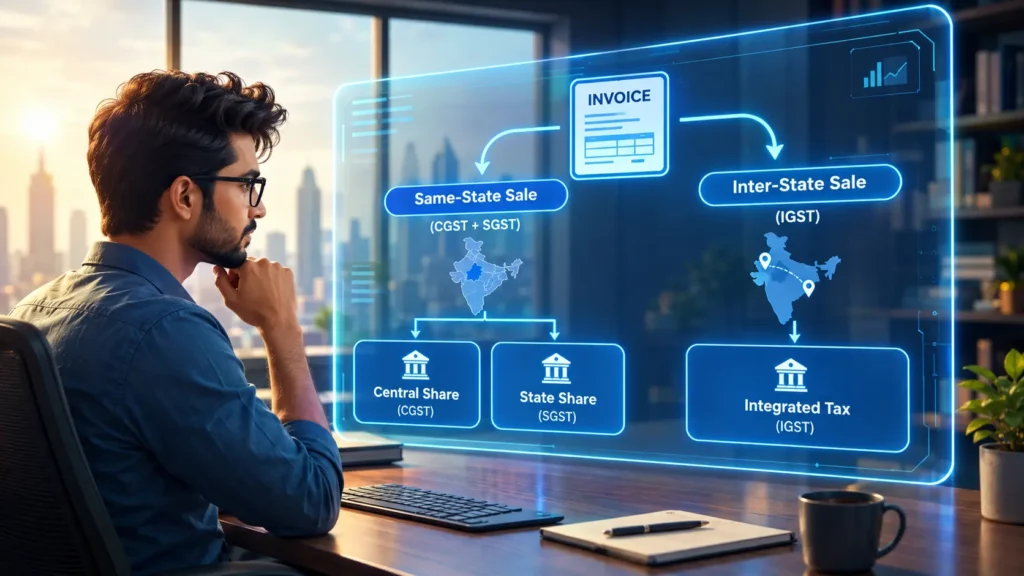
CGST (Central Goods and Services Tax) and SGST (State Goods and Services Tax) apply together for sales within the same state, splitting the tax 50/50 between the central and state governments. IGST (Integrated Goods and Services Tax) applies instead for inter-state sales, going to the central government to be settled with the destination state.
Since GST 2.0 took effect on September 22, 2025, most goods and services now fall under a simplified rate structure: 5% and 18% for most items, and 40% for luxury or sin goods – replacing the earlier 12% and 28% slabs. Always check the current rate for your specific HSN/SAC code before invoicing, since rates can be revised by the GST Council.
A real example: You invoice a client for a service worth ₹30,000, taxed at 18% under the current rate structure.
- Same state: CGST ₹2,700 + SGST ₹2,700 = ₹5,400 tax → Total ₹35,400.
- Different state: IGST ₹5,400 → Total ₹35,400
The total is identical either way – only how the tax is labeled and split changes, based on where your customer is registered.
Common Mistakes
1. Using the old 12% or 28% rate on invoices out of habit, instead of checking the current GST 2.0 rate for that HSN/SAC code
2. Leaving out the buyer’s address and state code on a B2C invoice of ₹50,000 or more
3. Reusing an invoice number from a previous financial year instead of resetting the sequence
4. Applying CGST + SGST when the sale is actually inter-state, or vice versa
5. Delaying a service invoice past the 30-day window
FAQ (Frequently Asked Questions):
Do I need a specific invoice format or software to be GST-compliant?
No. There’s no prescribed visual template – any layout works, as long as all 16 Rule 46 fields are present and correct.
What happens if I forget a mandatory field?
Your customer’s Input Tax Credit claim on that invoice can be denied, and it can be flagged during a GST audit or return-matching exercise.
Is e-invoicing required for small businesses?
Only if your annual aggregate turnover crosses ₹5 crore. Below that, a standard compliant invoice is enough.
Can I skip the HSN or SAC code if I’m a small business?
Generally, no – HSN/SAC codes are part of the mandatory fields under Rule 46, though the number of digits required can vary by turnover slab. Confirm the exact requirement for your turnover on the official GST portal.
Do invoice numbers need to follow a specific format?
They must be a unique, sequential number for the financial year, up to 16 characters, using only letters, numbers, hyphens, or slashes.
Final Takeaway
A GST-compliant invoice comes down to two things: including every field Rule 46 requires, and applying the correct current tax rate and split. The visual design doesn’t matter – the substance does. Since GST rates and thresholds are revised periodically, always confirm the current figures against the official GST portal or CBIC notifications before finalizing an invoice, rather than relying on a rate you used last year.
This article explains general GST invoicing rules and isn’t personal tax advice. For your specific situation, a GST practitioner or chartered accountant can confirm what applies to you.
Sources & References
- GST Portal (Government of India) – invoice rules and current notifications – https://www.gst.gov.in/
- Central Board of Indirect Taxes and Customs (CBIC) – Rule 46 of the CGST Rules, GST 2.0 rate notifications, e-invoicing threshold notification – https://www.cbic.gov.in/
Pingback: Freelance Business Growth India